English
  Русский
  Română
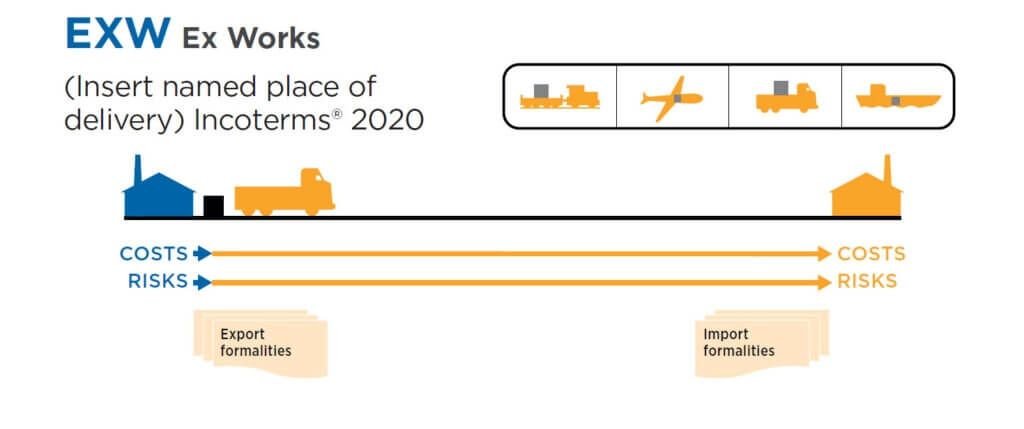
 EXW
Ex Works (insert named place of delivery)
The EXW Incoterm imposes only minimum obligations on the seller. More particularly, the seller is simply required to deliver the goods to the buyer at a named place of delivery which is usually the seller’s place of business, but can be any particular location such as a warehouse, factory, etc., and within the agreed time specified in the contract.
FCA
Free Carrier (insert named place of delivery)
When the named place of delivery is the seller’s premises, the goods are deemed to be delivered when they are loaded on the transportation vehicle arranged by the buyer;
When the named place of delivery is elsewhere, e.g., a warehouse or factory, etc., the goods are deemed to be delivered when the following requirements are met: after having been loaded on the seller’s transportation vehicle, they reach the named place, are ready for unloading from the seller’s transportation vehicle and are placed at the disposal of the carrier nominated by the buyer.
CPT
Carriage Paid to (insert place of destination)
Under the CPT Incoterm, the delivery of the goods occurs when they are delivered by the seller to the carrier at the agreed place or are procured by the seller so delivered. In this respect, the seller has an obligation to contract, at its expense, for the carriage of the goods from the point of delivery to the place of destination of the goods. The existence of the contract of carriage has no impact on the transfer of risk from the seller to the buyer which occurs at the point of delivery, i.e., by handing over the goods to the carrier.
CIP
Carriage and Insurance Paid To (insert place of destination)
Under the CIP Incoterm, the seller has the same obligations as under the CPT Incoterm, i.e., to hand over the goods to the carrier contracted by the seller and to clear the goods for export, with the addition of an obligation to contract for insurance in order to cover against the buyer’s risk/damage to the goods from the place of delivery to, at least, the place of destination.
DAP
Delivered at Place (insert named place of destination)
Under the DAP Incoterm, the goods are deemed delivered by the seller to the buyer when they are put at the disposal of the buyer on the transportation vehicle ready for unloading at the place of destination or an agreed point within such place, if any. Contrary to the CPT/CIP Incoterms, the place of delivery and the place of destination are the same under the DAP Incoterm. Therefore, the seller bears the risk until it has put the goods at the disposal of the buyer at the place of destination as described above.
DPU
Delivered at Place Unloaded (insert of the place of destination)
According to the DPU Incoterm, the delivery of the goods by the seller to the buyer occurs when the goods are unloaded from the transportation vehicle and put at the disposal of the buyer at the place of destination or at the agreed point within the place of destination, if any. It is the only Incoterm “that requires the seller to unload goods at destination.” Again, the place of delivery and the place of destination are the same under the DPU Incoterm. Therefore, the seller bears the risk until it has unloaded the goods at the place of destination.
DDP
Delivered Duty Paid (Insert place of destination)
Under the DDP Incoterm, the goods are supposed to be delivered by the seller to the buyer if they are placed at the disposal of the buyer, cleared for import, on the arriving transportation vehicle, ready for unloading at the place of destination or an agreed point within such place, if any. The DDP Incoterm imposes the maximum responsibility on the seller as it is the only Incoterm requiring import clearance by the seller.
FAS
Free Alongside Ship (insert name of the port of loading)
According to the FAS Incoterm, the seller delivers the goods when it either places them alongside the ship/vessel nominated by the buyer at the named port of shipment or it procures the goods so delivered. The risk/damage to the goods is transferred from the seller to the buyer when the goods are alongside the ship. The seller undertakes to clear the goods for export, not import.
FOB
Free on Board (insert named port of loading)
Under the FOB Incoterm, the goods are deemed to be delivered by the seller to the buyer when they are delivered on board the ship nominated by the buyer at the named port of shipment or the seller procures the goods so delivered. Therefore, the risk of loss/damage to the goods is shifted onto the buyer once the goods are placed on board the ship. The seller shall clear the goods for export, not import.
CFR
Cost and Freight (insert named port of destination)
According to the CFR Incoterm, the seller delivers the goods to the buyer by placing them on board the ship or procuring them so delivered. Therefore, the risk of loss of/damage to goods is shifted on the buyer when the goods are place on board of vessel at the port of delivery, and not the port of destination as in the case of the above-referenced FOB Incoterm.
CIF
Cost Insurance and Freight (insert named port of destination)
The regime of the CIF Incoterm is very similar to the one under the CFR Incoterm:
- the goods are to be delivered under the CIF Incoterm when the seller places them on board the ship or procures them so delivered;
- although the transfer of risk takes place at the port of delivery, the seller has an obligation to conclude a contract of carriage of the goods until the port of destination;
- the seller must bear all costs related to unloading at the port of destination resulting from the the contract of carriage, unless agreed otherwise;
- the seller has an obligation to clear the goods for export, not import.